
Ask most people what a strong core looks like and they'll describe a six-pack. Ask them how they train their core and they'll mention planks and crunches. Both answers are understandable — and both miss a significant piece of the picture.
The core isn't just about what's visible from the front. It's a three-dimensional system of muscles that work together to stabilise your spine, transfer force between your upper and lower body, and allow you to move powerfully in every direction. And one of the most important — and most consistently neglected — things it needs to do is rotate.
If rotation isn't in your training programme, you're leaving a gap that matters more than most people realise.

Your Body Moves in Three Planes — Most People Only Train Two
Here's a concept that changes how most people think about their training. All human movement happens across three planes of motion:
Sagittal — forward and back (squats, deadlifts, running, pressing)
Frontal — side to side (lateral lunges, lateral raises)
Transverse — rotation (twisting, turning, swinging)
The problem is that most gym programmes — especially beginner and intermediate ones — are almost entirely built around the sagittal plane. Squats, deadlifts, bench presses, rows. Brilliant exercises, all of them. But they don't train rotation. As one fitness resource from Mirafit puts it, neglecting the frontal and transverse planes "can create imbalances, limit functional performance, and increase risk of injury."
The transverse plane — rotation — is arguably the most neglected of the three, and it's the one that daily life and sport demand constantly.
What Rotation Actually Trains
Rotational movements engage the muscles that run along the sides of your torso — primarily the internal and external obliques — along with the deep core muscles, the spinal erectors, the hips, and the muscles of the thoracic spine. These aren't muscles that get much attention in a standard programme, but they're doing a great deal of work every single day.
Every time you reach across your body, carry a bag, turn to look over your shoulder, or get out of a car, you're using rotational muscles. The question isn't whether you rotate — it's whether your body is trained and prepared to do it properly.
Research published in the Journal of Bodywork and Movement Therapies has shown that rotational exercises are effective at building muscle and improving mobility, while experts in the field have long understood that rotational core training improves athletic power and functional movement. The science supports what good coaches have known for years: rotation is fundamental, not optional.
The Core Strength Argument
When most people train their core, they train it to resist movement — planks, dead bugs, hollow holds. These are valuable exercises. But a fully developed core also needs to be trained to create movement, specifically rotational movement.
The obliques, which are the primary drivers of trunk rotation, are frequently underdeveloped in people who focus only on sagittal plane training. A methodology study examining muscle activation during rotational and anti-rotational exercisesconfirmed that the core musculature — including the rectus abdominis, internal and external obliques, and erector spinae — is significantly activated during rotational movements, making them an effective and distinct stimulus for core development.
In short, if you want a genuinely strong core — not just one that looks strong — you need to train it to rotate. A plank trains endurance and anti-flexion. A wood chop or a cable rotation trains something different entirely: the ability to generate and control power through the torso in the transverse plane.
A strong core in every plane also means a more stable spine. Research consistently shows that well-trained trunk muscles improve posture, balance, and stability, and reduce the risk of lower back pain. Rotation training contributes directly to this by strengthening the muscles that support the spine from every angle.
Why Rotation Matters for Injury Prevention
Here's where the case gets compelling even for people who have no interest in sport. Lower back pain is one of the most common complaints in the general population, and a lack of rotational strength and thoracic mobility is a significant contributing factor.
The lumbar spine — your lower back — is not built for large amounts of rotation. Its primary job is stability. The thoracic spine — your mid-back — is where most healthy rotation should occur. When the thoracic spine is stiff and restricted, the lower back is forced to compensate and take on rotational stress it isn't designed to handle. Over time, this leads to strain, discomfort, and injury.
As the Journal of Strength and Conditioning has reported, improving thoracic rotation and rib cage mobility helps the body distribute rotational forces correctly — meaning the lower back doesn't have to absorb stress that should be handled elsewhere. Rotational exercises, done well, train the body to move as it should.
This matters whether you're a competitive golfer or someone who works at a desk. People who sit for long periods develop stiff, immobile thoracic spines. When they then reach, twist, or lift in daily life, the lower back bears the brunt of it. Adding deliberate rotation work into training is one of the most effective ways to address this — and to stay pain-free in the long run.

The Sporting Case: Golf, Tennis, and Throwing
For anyone who plays sport, the case for rotational training becomes even clearer. The most explosive and powerful sporting actions are fundamentally rotational. Golf swings, tennis groundstrokes, javelin throws, cricket batting, rugby passes — all of them derive their power from the ability to rotate rapidly and efficiently through the hips and trunk.
Golf
The golf swing is one of the most studied rotational movements in sport. Research published in PMC has shown that the velocity and timing of pelvic and upper torso rotation are key differentiators between professional and amateur golfers. It's not just about strength — it's about how efficiently rotational force is generated and transferred. Studies with junior and senior golfers have found that those following rotational training programmes saw meaningful improvements in club head speed over 12-week periods — translating directly to distance gains off the tee. Further research on elite golfersfound that an eight-week golf-specific programme including rotational and core work produced significant increases in torso rotational strength and improved balance.
Tennis
The demands of tennis are similarly rotational. Every forehand, backhand, and serve involves axial torque through the pelvis and trunk. Research cited in PMC has found that appropriate timing and velocity of pelvis and trunk rotation are critical to performance at all levels, and studies have shown that elite tennis players have significantly greater trunk rotational strength than novice players — and crucially, that they have symmetrical rotational strength, meaning no significant imbalance from side to side. Rotational training doesn't just develop power for these players; it also balances the body and reduces injury risk at the shoulder and lower back.
Throwing
For any sport that involves throwing — cricket, rugby, baseball, handball — rotational core strength is directly linked to both performance and injury resilience. A meta-analysis published in PubMed confirmed that core muscle training significantly enhanced standing ball throwing velocity. And a systematic review published in PMC found that after a six-week core and rotational stability programme, athletes showed a significant 4.9% increase in maximal throwing velocity compared to an unchanged control group. More power, delivered more efficiently, with a lower injury risk — that's what rotational training produces.
How It Makes You Stronger and More Robust
Even if you don't play sport, there's a strength argument for rotation training that's often overlooked.
Heavy compound lifts like squats and deadlifts demand anti-rotational stability — your core has to resist twisting forces to keep the barbell tracking correctly and your spine protected. But as experts have pointed out, this passive demand during sagittal plane lifts is not enough to fully develop rotational strength. Dedicated rotation work fills that gap.
The result is a more robust, resilient body. When your core can generate and resist force in all three planes — not just forward and back — your lifts become more stable, your posture improves, and your body handles unexpected loads and movements far better. You're not just stronger in the gym; you're more capable everywhere.
Think of it this way: a car that can only drive in a straight line is limited. The moment you need to corner, it fails. Training without rotation builds a body with a similar limitation. Rotational training is what gives you the ability to produce and absorb force in any direction — which is what real-world strength actually looks like.
What This Looks Like in Practice
Rotation exercises don't have to be complicated. Some of the most effective options include:
Medicine ball rotational throws — develops explosive rotational power
Cable wood chops — trains rotation through a full range of motion under load
Pallof press — an anti-rotation exercise that builds stability and core control
Landmine rotations — excellent for building rotational strength with joint-friendly loading
Russian twists / seated rotations — useful for training the obliques directly
Rotational lunges — combine lower body strength with rotational core demand
The key principle across all of them is the same: the hips and thoracic spine drive the movement, the core controls and transfers the force, and the lower back stays protected throughout.
The Bottom Line
If your training programme only moves in straight lines, it's incomplete. Your body is designed to rotate, daily life demands that you rotate, and sport rewards those who can rotate powerfully and safely. Rotation exercises develop the muscles responsible for this, protect the lower back from compensatory strain, and make you genuinely stronger and more capable across every plane of movement.
Adding rotation to your programme isn't a minor addition — it's addressing a gap that most programmes leave wide open.
If you'd like guidance on how to incorporate rotation work into a structured training programme, our AdMac Small Group Training sessions build this kind of balanced, well-rounded strength into every block — deliberately, progressively, and with proper coaching throughout.
Want to improve your health and fitness? Let the AdMac Fitness Personal Trainers help…
AdMac Fitness has been helping the people of East London transform their health and fitness for nearly a decade.
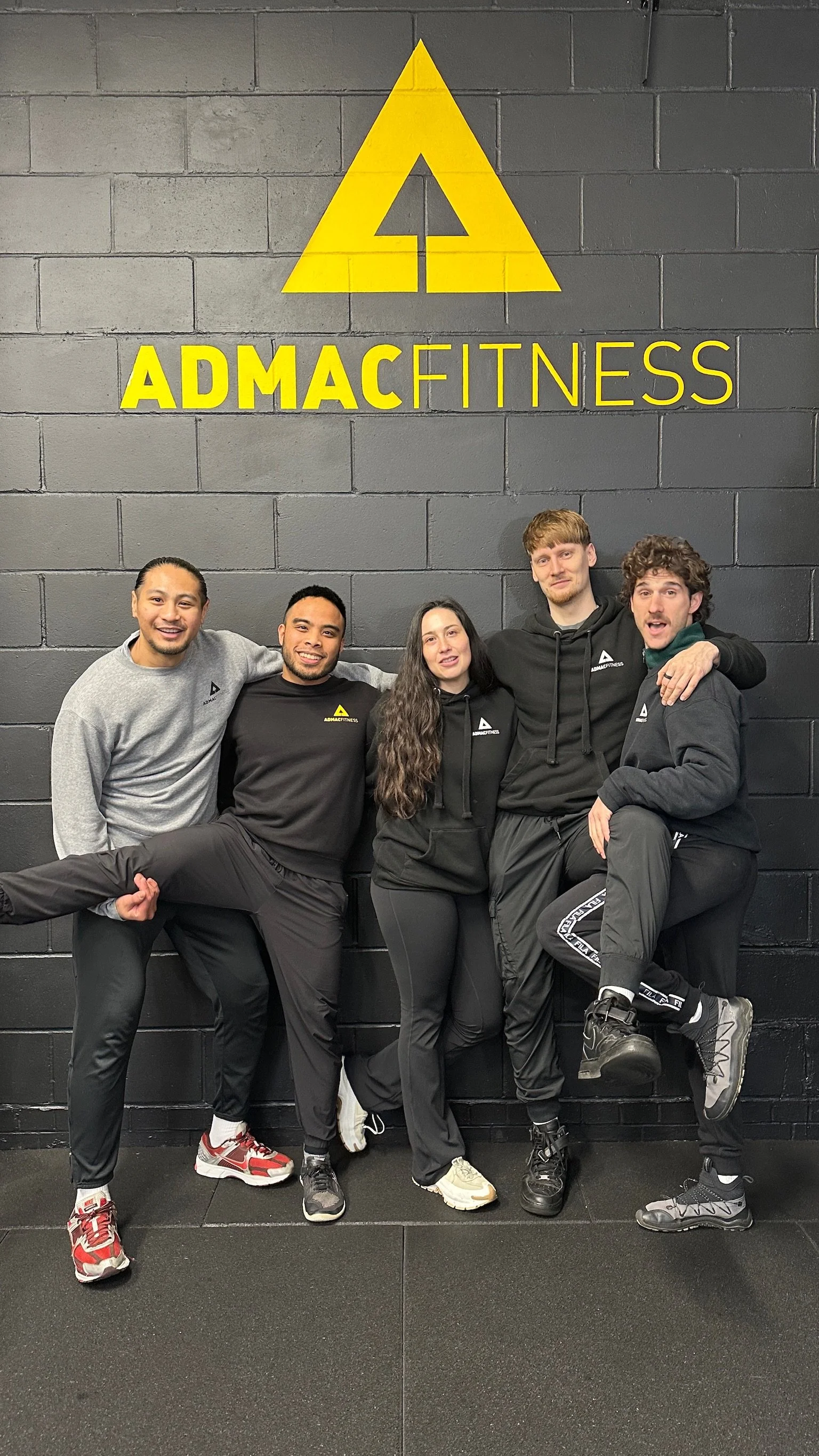
We help people using tried and tested fitness approaches. Our expert team of personal trainers, based in both Bow and South Woodford, can help you get a grip of your health forever. With our guidance and experience, you can relax knowing that your fitness journey is going to be guided by some of the best personal trainers in East London.
For more information on who we are, what we do and how we can help you achieve your health and fitness goals, contact us on… 07921465108 or email us at admacfitness@gmail.com. We look forward to hearing from you!
Our locations are…
AdMac Fitness: Arch 457 Robeson St, London E3 4JA
AdMac Fitness South Woodford: Unit 4 Marlborough Business Centre, 96 George Lane, South Woodford, London, E18 1AD